How to Choose a Travel Backpack: Easy Buying Guide
Published: 26 Aug 2026
Have you ever packed a travel backpack only to find that it feels too heavy, has too little space, or becomes uncomfortable after a few hours? Choosing the wrong backpack can make simple travel days harder, especially when you have to walk through airports, use public transport, or carry your bag from one place to another.
That is why knowing how to choose a travel backpack before buying one can save you from unnecessary discomfort and wasted money. You need a backpack that fits your body, holds your essentials, and matches the way you travel.
In this article, we will discuss how to choose a travel backpack in detail and explain the important factors you should consider before buying one. You will also learn how to avoid common mistakes and choose a backpack that feels right for your next trip.
How to Choose a Travel Backpack
The best travel backpack should fit your travel style. Think about your trip length, packing needs, and how often you carry it. Choose one that holds your essentials without feeling heavy or uncomfortable.
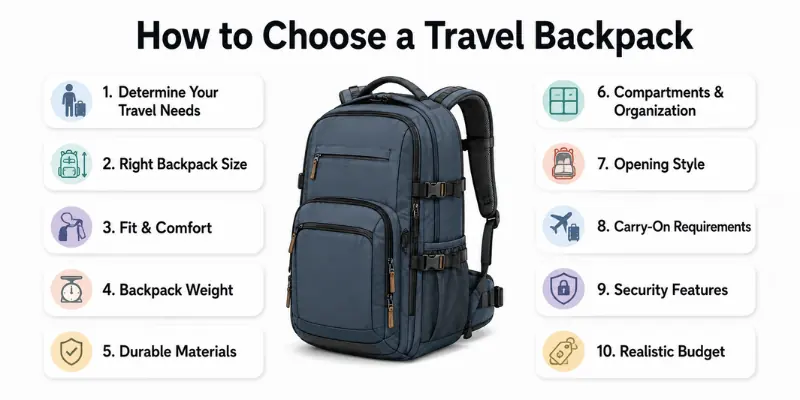
Here are the main steps to follow:
- Determine Your Travel Needs
- Right Backpack Size
- Check the Fit & Comfort
- Consider the Backpack Weight
- Look for Durable Materials
- Compartments & Organization
- Choose the Right Opening Style
- Carry-On Size Requirements
- Consider Security Features
- Set a Realistic Budget
Choosing your backpack becomes much easier when you consider these factors before making a purchase. Now, let’s look at each step in detail.
1. Determine Your Travel Needs
Start by thinking about the type of trips you usually take. A backpack for a two-day city trip does not need the same capacity or features as one for a long international journey. Your destination, transportation, activities, and packing habits should guide your choice.
- Consider how many days you normally travel.
- Think about whether you travel by plane, train, bus, or car.
- Decide whether you want to travel with one bag.
- Consider the clothes, shoes, electronics, and toiletries you carry.
- Think about how much walking you expect to do.
For example, I would choose a smaller and lighter backpack for a short city trip. For longer travel, I would look for more space, better support, and easier organization.
2. Right Backpack Size
Backpack size matters because more space can quickly lead to more packing. For most travelers, a backpack around 30 to 45 liters offers a useful balance between capacity and portability. Current travel guides also commonly place 35 to 45 liters in the practical range for travel, although your needs should decide the final size.
- 20 to 30L: Good for light packing and short trips.
- 30 to 40L: A practical range for many one-bag travelers.
- 40 to 45L: Useful when you need more clothing or equipment.
- Check the actual dimensions as well as the liter capacity.
- Avoid choosing a large backpack simply because it gives you more room.
I prefer choosing the smallest backpack that can comfortably hold everything I need. A smaller bag can encourage better packing and make long walks much easier.
3. Check the Fit & Comfort
Comfort should come before appearance. You may carry your backpack through airports, train stations, streets, hotels, and public transport. A bag that feels fine when empty can feel completely different when you fill it with your travel gear.
- Look for adjustable shoulder straps.
- Choose a padded back panel.
- Check whether the hip belt sits comfortably on your hips.
- Look for a sternum strap if you expect to carry heavier loads.
- Try the backpack with some weight inside before buying it.
Your torso length matters more than your overall height when you choose the right backpack fit. A poorly fitted pack can place too much weight on your shoulders and make walking uncomfortable.
If you are buying from a physical store, put the backpack on and walk around with it. Adjust the straps and pay attention to pressure points. This simple test can tell you more than looking at the backpack on a shelf.
4. Consider the Backpack Weight
Do not forget to check how much the backpack weighs when it is empty. You still need to add your clothes, shoes, toiletries, electronics, documents, and other essentials after that. A heavy backpack can quickly become difficult to carry.
- Check the empty backpack weight.
- Think about everything you plan to pack.
- Avoid unnecessary metal parts and bulky features.
- Choose lighter materials when they still provide enough durability.
- Leave some weight capacity for things you may buy during your trip.
I always think about the final packed weight, not just the size. A large backpack that weighs very little can sometimes work better than a smaller backpack with a heavy frame and lots of unnecessary features.
5. Look for Durable Materials
Your travel backpack will probably face more abuse than your everyday bag. You may place it under seats, on luggage racks, in car trunks, and on the ground. Strong fabric, stitching, and zippers can help it handle regular travel.
- Nylon offers a strong strength-to-weight ratio and good abrasion resistance.
- Polyester can provide good shape retention and often costs less.
- Ripstop fabrics can help limit small tears.
- Check the stitching around handles and straps.
- Look for quality zippers and reinforced stress points.
Do not choose a backpack based only on the fabric name. Construction also matters. Current backpack guides note that both nylon and polyester can work well, depending on the fabric construction and your priorities.
If you travel in rainy areas, also check whether the backpack has a water-resistant coating or water-resistant zippers. Remember that water-resistant does not always mean waterproof.
6. Compartments & Organization
A well-organized backpack can save you a lot of time during travel. You should not have to remove half of your clothes just to find your charger or passport. At the same time, you do not need a separate pocket for every small item.
- Look for a spacious main compartment.
- Check for a padded laptop compartment if you carry a computer.
- Choose quick-access pockets for passports and travel documents.
- Look for a water bottle pocket if you use one.
- Check whether the compartments match the things you normally carry.
Think about your personal packing habits here. If you carry a laptop, headphones, power bank, camera, and other electronics, choose a backpack that keeps them easy to access. If you mostly carry clothes, you may prefer a larger open main compartment.
7. Choose the Right Opening Style
The way a backpack opens can change how easy it is to pack. Traditional top-loading backpacks open from the top, while front-loading or clamshell designs open much more like a suitcase.
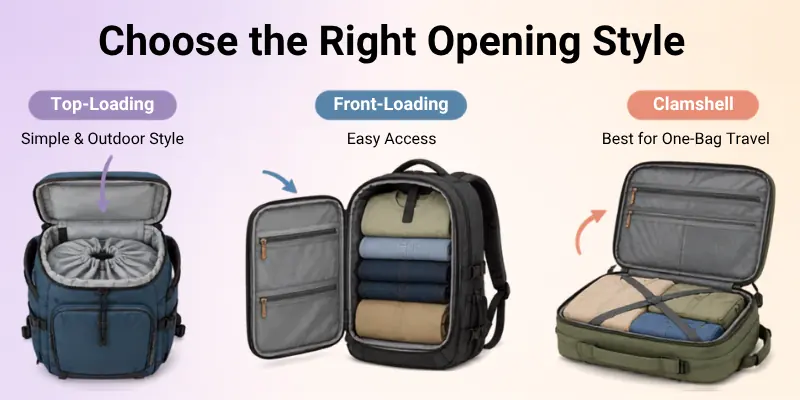
- Choose top-loading if you prefer a simple outdoor-style design.
- Choose front-loading for easier access to packed clothes.
- Consider a clamshell design for one-bag travel.
- Check how easily you can reach the bottom of the main compartment.
- Make sure the zippers open smoothly.
For travel, I usually prefer a front-loading or clamshell design because I can see more of my belongings without pulling everything out. Current travel guides also recommend panel-loading designs for easier access while traveling.
8. Carry-On Size Requirements
If you plan to take your backpack onto an airplane, check the airline’s rules before you buy it. Airlines set their own baggage conditions, and limits can vary by airline, cabin class, and aircraft. IATA also notes that baggage allowances remain airline-specific.
- Check your airline’s maximum carry-on dimensions.
- Check the allowed carry-on weight.
- Measure the backpack when it is fully packed.
- Check personal-item limits if you want to place the bag under the seat.
- Do not assume that a backpack advertised as “carry-on” will meet every airline’s rules.
As a general reference, IATA says many airlines use a maximum carry-on size around 56 × 45 × 25 cm, but you should always check the airline you will actually use.
This is one reason I would never buy a backpack based only on its liter capacity. The actual length, width, and depth matter at the airport.
9. Consider Security Features
Your backpack may hold your passport, wallet, phone, laptop, camera, and other valuable items. Good organization can already improve security, but a few additional features can make the bag easier to manage in busy places.
- Look for lockable zippers.
- Use hidden pockets for important documents.
- Check for a secure laptop compartment.
- Keep valuable items away from easy-access outer pockets.
- Choose compartments that allow you to keep important belongings close to you.
You do not need every anti-theft feature available. Focus on features that match your destination and travel habits. A simple hidden pocket may be more useful to you than a backpack packed with security features you never use.
10. Set a Realistic Budget
A higher price does not automatically make a backpack better for you. Before shopping, decide how much you are comfortable spending and then compare the features that actually matter.
- Set your budget before you start shopping.
- Prioritize comfort and durability.
- Compare materials and construction.
- Avoid paying extra for features you will not use.
- Think about how often you will use the backpack.
If you travel several times a year, spending more on a comfortable and durable backpack can make sense. If you travel only once or twice a year, you may not need a premium model.
The goal is not to find the most expensive travel backpack. The goal is to find one that gives you the features, comfort, and durability you need at a price you can afford.
Common Mistakes to Avoid When Choosing a Travel Backpack
Choosing a backpack becomes easier when you know what can go wrong. I have seen many travelers focus on appearance or storage space and forget about the things that matter once they start carrying the bag.
- Choosing a backpack that is too large
- Ignoring the empty weight
- Buying based only on appearance
- Ignoring proper fit
- Choosing too many unnecessary pockets
- Forgetting to check airline requirements
- Buying without testing the backpack
- Choosing the cheapest option without checking quality
The biggest mistake is buying more backpack than you actually need. Extra space often makes it easier to overpack, and every extra item adds weight to your back.
How to Test a Travel Backpack Before Buying
If you can test the backpack before buying it, take a few minutes to check how it feels. I would never judge a travel backpack only by looking at it because comfort becomes much more important once you fill it.
- Put the backpack on and adjust all the straps.
- Add some weight and walk around with it.
- Check whether the shoulder straps create pressure points.
- Make sure the hip belt sits comfortably.
- Open every main compartment and test the zippers.
Also check whether your most important items fit where you want them. Put your laptop, shoes, water bottle, charger, and other regular items inside if you can. This gives you a much better idea of whether the backpack suits your packing style.
Conclusion
In this guide, we have covered how to choose a travel backpack by looking at your travel needs, size, comfort, weight, materials, storage, security, and price. My personal recommendation is to focus on balance. A backpack should give you enough space without making you carry unnecessary weight, and it should offer useful features without becoming complicated or expensive.
Think about what you really need, check the backpack carefully, and make your final choice based on how you travel. Thank you very much for reading this guide, and I hope it makes your next backpack choice easier.
Now, take a moment to check the FAQs below. Don’t miss them, because you may find an answer or a useful idea that you have not considered yet.
FAQs: Choosing a Travel Backpack
Below, you will find answers to some common questions about choosing a travel backpack:
Look for the right size, comfortable fit, manageable weight, durable material, useful compartments, secure zippers, and suitable carry-on dimensions. Your travel style should guide the final choice.
For many travelers, 30 to 45 liters works well. Choose around 20 to 30 liters for lighter trips and consider 40 to 45 liters when you need more packing space. Your airline’s size limits should also influence your choice.
Yes. A 40L backpack can work well for one-bag travel, especially when you pack light. Your clothing, trip length, weather, and access to laundry will determine whether 40 liters gives you enough space.
A 30L backpack works well for short trips, minimalist packing, and travelers who want to keep their luggage light. It can also work as a personal item on some airlines, but you must check the specific airline’s dimensions.
Put the backpack on with some weight inside. Adjust the shoulder straps, hip belt, and sternum strap. The backpack should feel stable without creating painful pressure points on your shoulders, back, or hips.
Nylon and polyester can both work well. Nylon often suits travelers who want strong abrasion resistance and a good strength-to-weight ratio, while polyester can offer good shape retention and value. The overall construction also matters.
Many travel backpacks can work as carry-on bags, but the backpack must meet your airline’s size and weight limits. Airlines can use different requirements, so always check the current rules before your flight.
There is no single price that works for everyone. Set a budget based on how often you travel, then prioritize comfort, durability, and useful features instead of paying for features you do not need.
A backpack can make walking through airports, stairs, uneven streets, and public transportation easier because you keep your hands free. A suitcase can work better when you mainly travel between places with smooth floors and easy transport.
For long-term travel, look for a backpack with enough capacity, good weight distribution, comfortable straps, durable materials, and easy organization. A 35 to 45L backpack can be a practical starting point for travelers who want to pack light.




- Be Respectful
- Stay Relevant
- Stay Positive
- True Feedback
- Encourage Discussion
- Avoid Spamming
- No Fake News
- Don't Copy-Paste
- No Personal Attacks
- Be Respectful
- Stay Relevant
- Stay Positive
- True Feedback
- Encourage Discussion
- Avoid Spamming
- No Fake News
- Don't Copy-Paste
- No Personal Attacks
