How to Avoid Travel Scams: Easy Ways to Stay Safe Abroad
Published: 27 Aug 2026
Nothing ruins a trip faster than losing money to a fake booking, overpaying a taxi, or discovering that your cheap vacation rental does not even exist. These situations can leave you stressed, frustrated, and unsure about what to do next. Learning how to avoid travel scams can help you prevent these problems before they affect your trip.
You do not have to spend hours researching every possible scam to stay safe. With the right knowledge and a few simple habits, you can spot suspicious offers and make better decisions.
In this article, we will discuss how to avoid travel scams in detail, along with practical travel safety tips to help you travel with more confidence and fewer worries.
How to Avoid Travel Scams?
Let’s dive into the simple steps to help you avoid travel scams and enjoy a safer, stress-free trip. Steps to avoid travel scams:
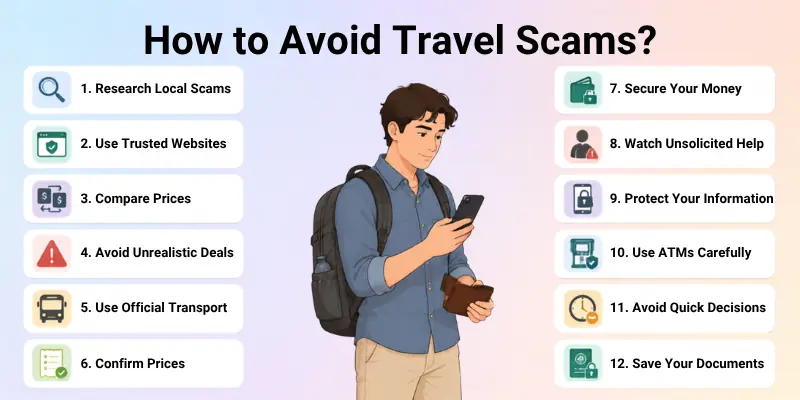
Steps to Avoid Travel Scams:
- Research Local Scams
- Use Trusted Websites
- Compare Prices
- Avoid Unrealistic Deals
- Use Official Transport
- Confirm Prices
- Secure Your Money
- Watch Unsolicited Help
- Protect Your Information
- Use ATMs Carefully
- Avoid Quick Decisions
- Save Your Documents
Following these simple steps can help you spot warning signs early and avoid many common travel scams.
1. Research Local Scams
Before I visit a new destination, I always think it is worth learning about the scams travelers commonly face there. Different places have different problems. One city may have taxi scams, while another may have fake tour guides, rental scams, or aggressive street sellers.
Search for terms such as travel scams in [destination], common scams in [destination], and tourist scams in [destination] before your trip. Read recent travel advice and reports from reliable sources.
The FTC also recommends researching travel companies, hotels, rentals, and agents with words such as “scam,” “review,” or “complaint” before paying.
A few minutes of research can make a big difference. When you already know what a scam looks like, you have a much better chance of recognizing it when it happens.
2. Use Trusted Websites
Online travel scams have become one of the biggest concerns for travelers. A fake website can look almost identical to the real website of an airline, hotel, travel agency, or rental company.
Before booking, check the website address carefully. Look for strange spellings, unusual domain names, missing contact information, or prices that seem far below the normal rate.
I recommend going directly to the company’s official website instead of clicking a booking link from an unexpected email, text message, or social media post. The FTC gave the same advice in its June 2026 travel scam alert, warning that scammers can use online ads, fake websites, and phone numbers that appear to belong to well-known travel companies.
Also check independent reviews before making a payment. Do not rely only on testimonials displayed on the website itself.
3. Compare Prices
A very low price can look attractive when you are trying to travel on a budget. However, an unusually cheap flight, hotel, rental, or tour deserves extra attention.
Compare the same service across several trusted websites. Check what the price includes and look for taxes, booking fees, cleaning fees, resort fees, or other additional costs.
For example, if several hotels charge around $100 per night and one unknown website offers the same type of room for $30, do not immediately assume you found a bargain. First, find out why the price is so different.
Price comparison does not guarantee that an offer is legitimate, but it can help you identify deals that need more investigation.
4. Avoid Unrealistic Deals
If someone offers you a luxury hotel, expensive tour, or “free vacation” for an unbelievable price, stop and check the details.
Scammers often use attractive offers to get your attention. They may advertise a free vacation and then ask you to pay taxes or fees. They may also advertise a premium hotel at a huge discount but refuse to provide the hotel’s exact name or address.
The FTC lists unclear details, extremely cheap vacation properties, pressure to pay, and “free” vacations that require payment as important warning signs.
I use a simple rule here: if the deal feels unusually good, verify it before you trust it.
5. Use Official Transport
Transportation scams can happen as soon as you leave an airport or train station. Someone may approach you and offer a taxi, private ride, or tour at a price that sounds reasonable. The problem may appear later when the driver demands much more money.
Whenever possible, use official taxi stands, airport transportation counters, licensed operators, or reputable ride services.
Before getting into a taxi, confirm the fare or ask whether the driver uses a meter. If you book a ride through an app, check the driver’s name, vehicle, and other identifying details before getting inside.
You should also learn the approximate local fare before your journey. That makes it much easier to recognize an inflated price.
6. Confirm Prices
Never assume that a price is obvious.
Ask how much something costs before you accept the service. This matters with taxis, tours, rentals, restaurants, guides, activities, and even luggage services.
For example, if someone offers to take you to a popular attraction, ask the total price before you agree. If a restaurant has no clear menu prices, ask before ordering.
I also recommend checking the final bill before paying. A quick look can help you catch an extra item, incorrect amount, or unexpected charge.
7. Secure Your Money
Your money becomes more important when you are far from home, so keep it secure.
Avoid carrying all your cash, cards, and important documents in one place. Keep some emergency money separately from your main wallet.
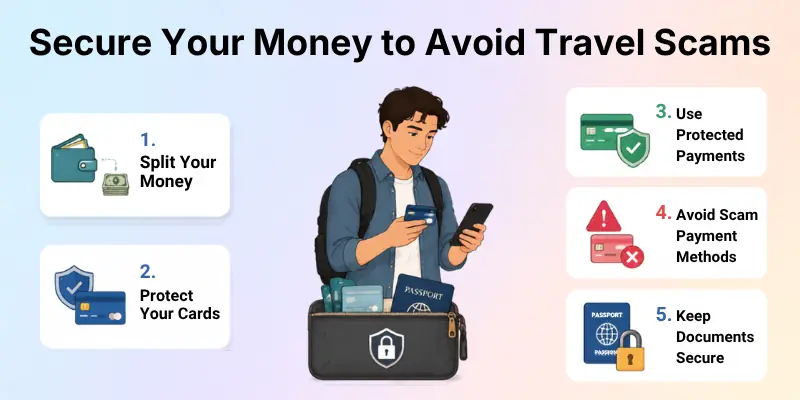
When possible, use a payment method that gives you protection against unauthorized charges. The FTC has advised travelers to consider credit cards because they can provide more protection than cash or some other payment methods.
Be especially careful if someone tells you that you must pay with a wire transfer, gift card, cryptocurrency, or another difficult-to-reverse method. The FTC identifies these payment demands as major scam warning signs.
8. Watch Unsolicited Help
Most people you meet while traveling may be friendly and helpful, but you should still stay aware when strangers suddenly approach you.
Someone may offer to carry your luggage, show you a hidden attraction, help with an ATM, or guide you somewhere. The offer may seem harmless, but it can sometimes lead to an unexpected fee or distraction while another person takes your belongings.
You do not need to be rude. A simple “No, thank you” is enough if you do not need help.
If you actually need assistance, I prefer asking staff at your hotel, airport, train station, official tourist office, or another established business.
9. Protect Your Information
Your personal information can be just as valuable to a scammer as your money.
Do not give strangers your passport details, card number, PIN, password, account login, or verification code unless you know exactly why they need it.
Be careful with unexpected travel messages too. A message may claim that your flight has been canceled, your hotel payment failed, or you need to confirm your booking. Instead of clicking the link, visit the company’s official website or contact the company using information you already know is genuine.
The FTC advises consumers not to click links in unexpected messages and to contact the organization through a trusted website or phone number instead.
10. Use ATMs Carefully
ATMs can become a target for card theft and other payment scams.
Use ATMs located inside banks, reputable businesses, or other secure places when possible. Before inserting your card, check the machine for anything unusual.
Cover the keypad when entering your PIN, and never allow a stranger to “help” you with your transaction.
If an ATM keeps your card, do not accept help from a random person nearby. Contact the bank or ATM operator directly using a trusted phone number.
Also check your bank account regularly during your trip. Early detection can help you respond quickly if you notice an unauthorized transaction.
11. Avoid Quick Decisions
Pressure is one of the biggest warning signs I look for when dealing with an unfamiliar travel offer.
A person may tell you that a hotel room will disappear in five minutes, a tour price will double immediately, or you must pay right now to avoid losing your reservation.
Do not let that pressure make the decision for you.
Take a few minutes to verify the company, price, terms, and payment method. Legitimate businesses should normally give you enough information to understand what you are buying.
The FTC specifically warns travelers about offers that pressure them into making quick decisions.
12. Save Your Documents
Keep copies of important travel documents, including your passport, visa, insurance information, booking confirmations, tickets, and payment receipts.
You can keep secure digital copies and carry only the documents you actually need.
Save your hotel confirmation and booking details too. If a hotel or rental host says they cannot find your reservation, your confirmation can help you prove what you booked and what you paid.
Keeping records also helps if you need to contact your bank, booking platform, insurance provider, or local authorities after a problem.
Common Travel Scams to Watch Out For
Knowing the most common travel scams can make it easier to recognize them before you lose money.
Fake Travel Websites: A scammer creates a website that looks like a real airline, hotel, rental company, or travel agency. You make a payment and later discover that the website was fake. Always check the website address and verify the company through its official website.
Fake Vacation Rentals: Scammers may copy a real property listing or create a completely fake rental. You may pay in advance and arrive at the destination to discover that the property does not exist or does not belong to the person who took your money.
Taxi Scams: A driver may charge an inflated fare, refuse to use the meter, take a longer route, or add unexpected fees. Use official transportation and confirm the price before you start.
Fake Tour Guides: Someone may approach you near a tourist attraction and offer a cheap tour. Afterward, they may demand a much higher payment or take you to businesses where they receive commissions.
Currency Scams: Currency scams can include poor exchange rates, hidden fees, fake notes, or incorrect change. Check the current exchange rate and count your money before leaving the exchange counter.
ATM Scams: Scammers may try to distract you at an ATM or use devices designed to steal card information. Choose secure ATMs and never share your PIN.
Fake Officials: A person may pretend to be a police officer, government worker, or another official and demand money or personal information.
Stay calm and verify their identity through an official source if you have doubts. The U.S. Department of State also warns travelers about scams that target people abroad and recommends protecting personal details and being cautious about offers that seem too good to be true.
What to Do If You Get Scammed While Traveling
Even careful travelers can become victims of a scam. If it happens, focus on stopping the damage instead of blaming yourself.
Stop Further Payments: If you realize that something feels wrong, do not send more money. Scammers may tell you that another payment will solve the problem or help you receive a refund. Do not fall for that second request.
Contact Your Bank: If you paid by card or transferred money, contact your bank or payment provider as soon as possible. Explain what happened and ask what options you have to protect your account or dispute the transaction.
Secure Your Accounts: Change passwords if you shared login information. Monitor your bank and card accounts for unusual activity. If you lost your phone, passport, or other important documents, take steps to secure those accounts and documents as quickly as possible.
Report the Scam: Report the scam to the company or booking platform involved. You can also report it to the appropriate local authorities or consumer protection agency. Reporting helps create a record of the problem and may help protect other travelers.
Save Your Evidence: Keep screenshots, emails, messages, receipts, booking confirmations, payment records, names, phone numbers, and website addresses connected to the scam.
These details can help when you contact your bank, booking platform, insurer, or authorities.
Conclusion
In this guide, we have covered how to avoid travel scams and learned how a little preparation can protect you from many common problems. I recommend staying aware while also giving yourself the freedom to enjoy your destination. Scams can happen, but you can manage many of the risks by researching local scams, checking prices, using secure payment methods, and thinking twice before accepting an offer that feels unusual.
Stay careful, but do not let worry take away the joy of traveling. Thank you for spending your time with me, and I wish you a safe, enjoyable, and memorable journey.
Don’t skip the next part of the FAQs. I hope you will find something more interesting, so don’t miss it. If you miss it, you may lose something new.
FAQs: How to Avoid Travel Scams
Still have questions about how to avoid travel scams? Check out the FAQs below for simple answers to common questions and practical tips to help you travel more safely.
Common travel scams include fake travel websites, taxi scams, fake tour guides, vacation rental scams, ATM scams, and currency scams. Scammers may also use fake discounts or free vacation offers to attract travelers. Knowing these common travel scams can help you recognize warning signs before you lose money.
Check the website address carefully and look for unusual spellings or suspicious domain names. Search the company name with words like “scam,” “review,” or “complaint” before making a booking. These fake travel websites often use attractive deals to collect your money or personal information.
Book flights, hotels, and tours through the company’s official website or a trusted booking platform. Compare prices and check the cancellation, refund, and payment policies before you pay. These simple steps can reduce your risk of becoming a victim of travel booking scams.
Use official taxis, airport transportation services, or reputable ride services whenever possible. Confirm the fare or make sure the meter works before the journey starts. Checking the normal local fare beforehand can also help you spot taxi scams.
Stop and compare the offer with prices from several trusted travel companies. Ask for complete details about the hotel, rental, tour, fees, cancellation policy, and payment method before agreeing. An unusually cheap deal can be a warning sign of a travel scam, especially when someone pressures you to pay quickly.
Check that the property exists and compare its address, photos, and details with information from trusted sources. Read independent reviews and avoid hosts who insist that you pay outside the normal booking platform. These vacation rental scams often involve fake properties or prices that sit far below similar rentals.
Use secure payment methods and avoid anyone who demands payment through gift cards, wire transfers, or cryptocurrency. Keep your card details and PIN private and check your account for unusual transactions. Good travel safety tips include carrying a backup payment option and avoiding payments that you cannot easily recover if something goes wrong.
Choose ATMs inside banks or other secure locations instead of using unfamiliar machines in isolated areas. Check the ATM for anything unusual, cover your PIN, and never let a stranger handle your card. These ATM scams can involve card theft, stolen PINs, or attempts to access your account.
Do not click links in unexpected emails or text messages about flights, hotels, refunds, or payments. Instead, visit the company’s official website directly or contact it using a phone number you already trust. This approach can help protect you from travel phishing scams that try to steal your login or payment information.
Stop making further payments and contact your bank or payment provider as soon as possible if money or card information is involved. Save screenshots, receipts, messages, booking details, and other evidence before reporting the scam to the relevant company or authorities. Acting quickly is an important part of travel scam prevention and can help limit further damage.



- Be Respectful
- Stay Relevant
- Stay Positive
- True Feedback
- Encourage Discussion
- Avoid Spamming
- No Fake News
- Don't Copy-Paste
- No Personal Attacks
- Be Respectful
- Stay Relevant
- Stay Positive
- True Feedback
- Encourage Discussion
- Avoid Spamming
- No Fake News
- Don't Copy-Paste
- No Personal Attacks
