What Is Space Tourism & How It Works
Published: 17 Jun 2026
Travel has evolved from land journeys to air travel and now even beyond Earth. Many people are curious about what is space tourism and how it works. Space tourism is one of the newest and most exciting forms of travel in the modern world.
It allows private individuals to travel into space for recreational, leisure, or adventure purposes. Although it was once only possible for trained astronauts, private companies are now making space travel available to civilians.
In this detailed guide, you will learn everything about space tourism in simple and easy language.
What Is Space Tourism?
What is space tourism? It is the commercial activity of sending private individuals into space for non scientific purposes. Unlike traditional space missions led by government agencies, space tourism focuses on civilian travel experiences.
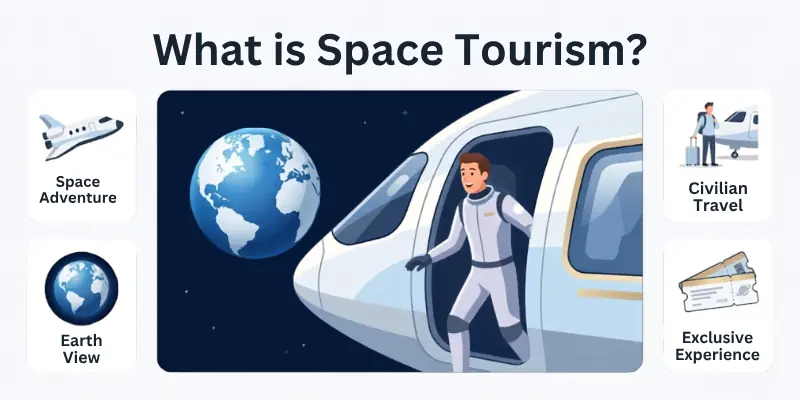
Space tourists can travel to suborbital space, orbit the Earth, or potentially visit space stations in the future. The main purpose is adventure, unique experiences, and viewing Earth from space. It is considered one of the most exclusive and expensive forms of tourism today.
Space tourism represents a new era where space is no longer limited to professional astronauts.
Types of Space Tourism
Space tourism includes different types of experiences depending on altitude and duration.
1: Suborbital Space Flights: Suborbital flights take passengers just beyond the boundary of space for a few minutes. Companies like Blue Origin offer short trips that allow passengers to experience weightlessness and see Earth from above.
2: Orbital Space Flights: Orbital flights travel around Earth and remain in space longer. SpaceX has conducted private orbital missions that circle the planet.
3: Future Space Station Visits: In the future, private travelers may visit commercial space stations. NASA and private companies are working on partnerships to expand these opportunities.
4: Lunar Tourism: Although still in development, some companies aim to send private passengers around the Moon in the coming years.
Benefits of Space Tourism
Space tourism offers several potential benefits.
- It encourages innovation in space technology and aerospace engineering.
- It creates new business opportunities in the commercial space industry.
- It inspires interest in science and space exploration.
- It generates revenue for further research and development.
- It promotes global collaboration in space programs.
- It expands human access beyond Earth.
- It motivates younger generations to study science and technology.
- It supports economic growth in advanced industries.
Challenges of Space Tourism
Despite its excitement, space tourism faces many challenges.
- Extremely high costs limit access to wealthy individuals.
- Safety risks remain a major concern.
- Rocket launches have environmental impacts.
- Training requirements can be physically demanding.
- Space travel technology is still developing.
- Regulations and legal frameworks are complex.
- Emergency response systems in space are limited.
How Space Tourism Works
Space tourism requires advanced spacecraft and launch systems. Passengers usually complete short training sessions before the flight. These sessions prepare them for safety procedures and zero gravity experiences.
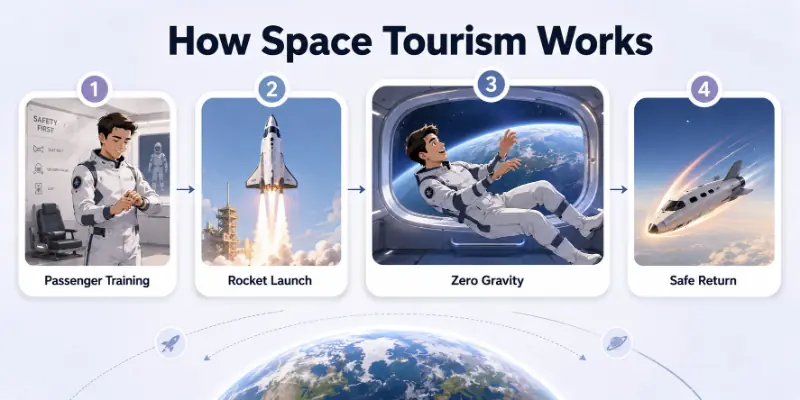
A rocket carries the spacecraft beyond Earth’s atmosphere. During suborbital flights, passengers experience a few minutes of weightlessness and view Earth from space before returning safely. Orbital missions last longer and involve traveling around the planet.
Private companies are investing heavily in reusable rockets to reduce costs and improve safety.
Cost of Space Tourism
Space tourism is currently very expensive. Ticket prices for suborbital flights can cost hundreds of thousands of dollars. Orbital missions may cost tens of millions of dollars per seat.
As technology improves and competition increases, prices may decrease in the future. However, for now, space tourism remains a luxury experience for a small number of people.
Environmental Impact of Space Tourism
Rocket launches release emissions into the atmosphere. Scientists are studying the environmental effects of increased space travel. Companies are researching cleaner fuels and reusable rockets to reduce impact.
Balancing innovation with environmental responsibility will be important for the long term future of space tourism.
Future of Space Tourism
The future of space tourism looks ambitious and innovative. Companies are developing larger spacecraft and planning commercial space stations. Some experts believe space hotels may become possible in the coming decades.
As technology advances, costs may decrease and safety standards may improve. Governments and private companies are working together to create clear regulations. Space tourism may eventually become more accessible to a wider audience.
Final Thoughts
In this guide, we have clearly explained what is space tourism and how it is changing the future of travel. It is a bold step that moves tourism beyond Earth into outer space.
Although it is currently expensive and limited, it represents innovation and human curiosity. With technological progress and responsible development, space tourism may become more accessible in the future. It shows that travel possibilities are expanding beyond our planet.
FAQs About Space Tourism
Here are some of the most commonly asked questions related to what is space tourism:
Space tourism means traveling to space for fun or adventure instead of scientific work. Private companies offer these trips to civilians. Passengers can experience weightlessness and see Earth from space. It is a commercial activity.
Space tourism is very expensive. Suborbital flights can cost hundreds of thousands of dollars. Orbital missions may cost millions. Prices may decrease in the future as technology improves.
Space tourism includes safety measures and training programs. However, space travel always carries risks. Companies follow strict testing and engineering standards. Safety remains a top priority in the industry.
Private aerospace companies like Blue Origin and SpaceX are leaders in space tourism. They design spacecraft and manage missions. Governments also support regulations. The industry is still growing.
Suborbital flights usually last about ten to fifteen minutes. Orbital missions can last several days. The duration depends on the type of mission. Future trips may last even longer.
Yes, passengers complete basic training before flight. Training includes safety procedures and preparation for zero gravity. It usually lasts a few days. The training ensures a safe experience.
Experts believe costs may decrease over time. Reusable rockets and competition may reduce ticket prices. However, it may take many years. For now, it remains limited to wealthy travelers.
Space tourism encourages technological innovation. It funds further space research. It inspires global interest in science. It opens a new chapter in human exploration.






- Be Respectful
- Stay Relevant
- Stay Positive
- True Feedback
- Encourage Discussion
- Avoid Spamming
- No Fake News
- Don't Copy-Paste
- No Personal Attacks
- Be Respectful
- Stay Relevant
- Stay Positive
- True Feedback
- Encourage Discussion
- Avoid Spamming
- No Fake News
- Don't Copy-Paste
- No Personal Attacks
