Travel vs Tourism: What’s the Difference?
Published: 22 May 2026
Many people confuse the concepts of travel and tourism because they seem similar at first glance. Both involve moving from one place to another, exploring destinations, and having experiences.
However, these terms carry different meanings, serve different purposes, and apply to different scenarios. Although interconnected, each term has its own scope, objectives, and economic impact.
In this detailed guide, we will break down all aspects of travel vs Tourism, highlight their key differences, and help you clearly understand how they operate in real-world contexts.
Travel vs Tourism
Understanding travel vs tourism requires examining multiple factors that define their meanings and applications.
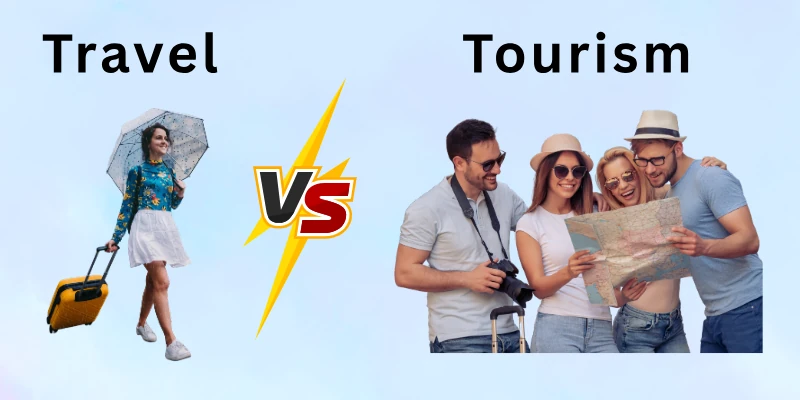
Below are the major comparison factors we will use:
- Purpose & Motivation
- Duration
- Scope & Activities
- Economic Impact
- Planning & Management
- Documentation & Requirements
- Experience & Interaction
- Industry Perspective
Let us cover all these differences in detail.
1. Purpose & Motivation
Purpose refers to the reason why someone undertakes a journey. Motivation involves the psychological or practical triggers behind movement. Every movement from one place to another has an underlying purpose.
Travel can be driven by personal needs, while tourism is more defined and recreational. Understanding purpose helps separate casual movement from structured leisure experiences.
How Travel Differs:
- Can be for work, education, health, family, or leisure
- Not always leisure-focused
- Often tied to necessity or functional goals
- May lack structured planning
- Motivations are diverse and personal
How Tourism Differs:
- Primarily for recreation, leisure, or enjoyment
- Includes sightseeing and holiday experiences
- Motivations are pleasure-oriented
- Often involves paid tourism services
- Focuses on relaxation and entertainment
2. Duration
Duration refers to the period spent away from the usual place of residence. Different types of movement may be short, moderate, or long depending on the purpose. Duration also influences cost, activities, and planning requirements.
How Travel Differs:
- Duration may vary widely
- No fixed minimum or maximum duration
- Can be long-term (e.g., study abroad)
- Can be short (e.g., business day trips)
- Not bound by leisure timelines
How Tourism Differs:
- Usually short to medium term
- Often has defined vacation periods
- Commonly ranges from 1 day to a few weeks
- Influenced by holiday seasons
- Rarely long-term stays for non-work purposes
3. Scope & Activities
Scope refers to the range of actions involved. Activities relate to what individuals do during movement. These help determine whether someone is simply traveling or engaging in tourism.
How Travel Differs:
- Broad variety of everyday activities
- Work, study, medical visits, errands, etc.
- May not include sightseeing
- Not necessarily serviced by tourism industry
- Supports personal or professional needs
How Tourism Differs:
- Recreational sightseeing and excursions
- Museum visits, theme parks, beaches, attractions
- Guided tours and cultural experiences
- Hospitality and hospitality services involved
- Purely leisure and entertainment focus
4. Economic Impact
Economic impact is related to how movement interacts with industries and produces income. While travel is a more general human activity, tourism is frequently examined as an economic sector.
How Travel Differs:
- Not always linked to tourism spending
- May not benefit local hospitality industry
- Business travel does impact economy differently
- Spending varies depending on needs
- Not classified as an economic sector alone
How Tourism Differs:
- Major contributor to global and local economies
- Supports hotels, restaurants, transport & attractions
- Creates employment and infrastructure growth
- Tracked by governments as an economic sector
- Generates significant foreign exchange
5. Planning & Management
This is a reflection of the manner in which the movement is anticipated and supported. The tourism industry frequently involves service providers, despite the fact that travel can be unstructured or self-directed.
How Travel Differs:
- May be spontaneous or unplanned
- Requires minimal arrangements sometimes
- Business travel planned by organizations
- Can be independent and flexible
- Not always reliant on travel agencies
How Tourism Differs:
- Often involves tour operators and guides
- Requires booking hotels, tours, packages
- Structured itineraries and schedules
- Managed by the tourism service sector
- Focuses on customer experience
6. Documentation & Requirements
Certain journeys require the completion of paperwork or the acquisition of permissions. It is important to note that the documentation is highly variable depending on the type of movement and the reason for movement.
How Travel Differs:
- May require visas, passports, work permits
- Business travelers may need invitations
- Students require educational documents
- Can include transport tickets only
- Needs vary widely by purpose
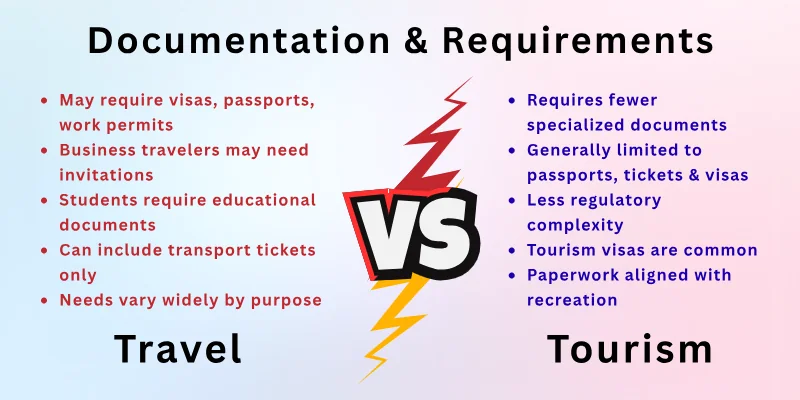
How Tourism Differs:
- Requires fewer specialized documents
- Generally limited to passports, tickets & visas
- Less regulatory complexity
- Tourism visas are common
- Paperwork aligned with recreation
7. Experience & Interaction
The way that people feel while moving is determined by their experiences. Engaging with different cultures, services, and environments is what we mean when we talk about interaction.
How Travel Differs:
- Experiences may be task-oriented
- Limited cultural interaction during business trips
- Practical rather than emotional outcomes
- Not always immersive
- May lack touristic exploration
How Tourism Differs:
- Highly experience-driven
- Deep cultural and social interactions
- Focus on memories, fun, and enjoyment
- Immersive sightseeing and activities
- Emotional value is high
8. Industry Perspective
In contrast to travel, which is a more general concept that has an impact on a variety of different fields, tourism is a well-organized sector when viewed from the perspective of the industry.
How Travel Differs:
- Part of transportation and mobility sectors
- Not an industry by itself
- Includes logistics, aviation, and commuting
- Supports various industries indirectly
- Considered a general human activity
How Tourism Differs:
- A recognized global industry
- Includes hospitality, travel services, attractions
- Governed by tourism boards and ministries
- Works with marketing and destination branding
- Economically measurable sector
Combined Importance
While there are clear distinctions between the two, both travel and tourism work together to support mobility, cultural exchange, and global development.
The travel and tourism comparison shows that travel is a broader term that encompasses any form of movement, while tourism specifically refers to leisure-oriented travel supported by structured services.
Together, they increase global connectivity, support economic growth, and promote international understanding.
Final Note
In this guide, we have covered the complete breakdown of travel vs Tourism, explained all the differentiating factors, and clarified how each concept functions. Both terms are related but not identical, and understanding their differences helps in academic, business, and practical contexts.
Personal Advice
If you are planning to explore the world, identify whether your goal is simply to travel for personal purposes or engage in tourism for leisure. This will help you plan better, budget accurately, and select the right experience for your needs.
FAQs
Here are some of the most commonly asked questions related to travel vs. tourism:
The difference between travel and tourism is that travel refers to any movement from one place to another, while tourism specifically involves recreational or leisure travel. Tourism is a structured industry, whereas travel is a broader human activity.
Not necessarily, because travelers may be moving for reasons such as work, study, or healthcare. Tourists specifically travel for leisure and recreation, making every tourist a traveler but not every traveler a tourist.
People confuse them because both involve moving and visiting places. However, tourism has a leisure focus, while travel serves many purposes beyond recreation.
Tourism is supported by hospitality, transportation, food and beverage, entertainment, and tour services. These industries collectively create tourism experiences and revenue.
Tourism boosts local economies through spending on hotels, food, transportation, and attractions. It creates jobs and generates revenue for governments.
Yes, traveling can be independent, spontaneous, or necessity-based without using tourism-related services. For example, business trips or family visits may require minimal leisure activities.
Tourism management involves planning and organizing tourism activities, services, and destinations. It ensures tourists have a smooth experience while benefiting local communities.
Business travel is purpose-driven and usually work-related. Tourism is leisure-driven and focuses on enjoyment, experiences, and entertainment.
Depending on the destination, tourists may need passports, tickets, and visas. Documentation is usually simpler compared to work or study travel.
Yes, tourism allows people to experience different cultures, traditions, and lifestyles. This leads to better global understanding and social harmony.





- Be Respectful
- Stay Relevant
- Stay Positive
- True Feedback
- Encourage Discussion
- Avoid Spamming
- No Fake News
- Don't Copy-Paste
- No Personal Attacks
- Be Respectful
- Stay Relevant
- Stay Positive
- True Feedback
- Encourage Discussion
- Avoid Spamming
- No Fake News
- Don't Copy-Paste
- No Personal Attacks
