Solo Travel vs Group Travel: What’s the Difference?
Published: 11 Aug 2026
Many travelers find themselves confused when choosing between solo travel and group travel because both approaches offer meaningful and enjoyable experiences. While solo travel is associated with independence, flexibility, and self-discovery, group travel focuses on shared experiences, social bonding, and guided convenience.

Although they are both part of modern tourism, they differ significantly in planning, motivation, safety, budgeting, and personal expectations.
In this comprehensive guide, we will explore every aspect of solo travel vs group travel, highlight their key differences, and help you identify which mode suits your preferences and travel goals.
Solo Travel vs Group Travel
Understanding solo travel vs group travel requires comparing multiple factors that influence preparation, experience, and outcomes. Below are the main comparison factors we will use:
- Planning & Organization
- Flexibility & Control
- Safety & Risk
- Social Experience
- Budget & Expenses
- Purpose & Motivation
- Decision-Making
- Cultural Interaction
- Travel Pace & Itinerary Style
Let us cover all these differences in detail.
1. Planning & Organization
Planning refers to arranging accommodation, transportation, routes, and travel schedules. Organization determines how structured and guided a travel experience is. These factors impact stress levels, comfort, and readiness before the trip begins. Solo and group travel differ notably in how planning is approached and executed.
How Solo Travel Differs:
- Traveler handles all planning alone
- Full responsibility for booking and research
- Higher time investment in preparation
- Self-guided tours and personal schedules
- Requires good organizational skills
How Group Travel Differs:
- Planning often handled by organizers or guides
- Less personal responsibility for logistics
- Pre-arranged packages and itineraries
- Reduced time pressure during preparation
- Ideal for those avoiding travel administration
2. Flexibility & Control
Flexibility refers to how freely a traveler can change schedules, routes, or activities. Control reflects decision power over how the journey unfolds. This factor is central to traveler satisfaction and comfort.
How Solo Travel Differs:
- Maximum flexibility for sudden changes
- Can choose destinations at any moment
- Complete control over timing and pace
- Can skip or add activities freely
- No group coordination required
How Group Travel Differs:
- Fixed schedules and routes
- Less freedom to modify plans
- Decisions must suit everyone
- Set departure and return times
- Coordination required for group consistency
3. Safety & Risk
Safety refers to physical, emotional, and environmental protection while traveling. Risk includes crime, emergencies, or travel mistakes that may occur along the way. Safety perceptions vary depending on destination and traveler experience.
How Solo Travel Differs:
- Higher responsibility for personal safety
- Must solve emergencies independently
- More challenging in unfamiliar areas
- Risk of loneliness or isolation
- Requires awareness and planning
How Group Travel Differs:
- Safer due to numbers and supervision
- Group members assist in emergencies
- Reduced exposure to travel-related risks
- Guided tours offer secure environments
- Higher sense of protection and support
4. Social Experience
Social experience relates to how many interactions, relationships, or shared moments a traveler experiences. This influences emotional satisfaction, bonding, and cultural exchange.
How Solo Travel Differs:
- Experience is self-focused and introspective
- Less social interaction unless initiated
- Encourages independence and self-discovery
- Can feel lonely at times
- Ideal for those who enjoy solitude
How Group Travel Differs:
- Encourages interaction and bonding
- Shared memories and collective fun
- Opportunity to meet new people
- Reduced chances of loneliness
- Ideal for social and extroverted travelers
5. Budget & Expenses
Budget refers to how much money is spent during travel. Expenses include transportation, accommodation, food, and activities. Travel mode influences cost distribution and financial management.
How Solo Travel Differs:
- Higher cost per person for rooms and transport
- No cost-sharing opportunities
- Full financial responsibility on traveler
- Flexible budgeting based on personal spending
- Can choose cheaper or premium options freely
How Group Travel Differs:
- Costs can be shared (rooms, taxis, etc.)
- Group packages are often cheaper
- Discounts available for bulk bookings
- Easier expense management in tours
- Less financial flexibility for changes
6. Purpose & Motivation
Purpose refers to the goal behind the trip, like exploration, learning, healing, or recreation. Motivation influences emotional outcomes and expectations.
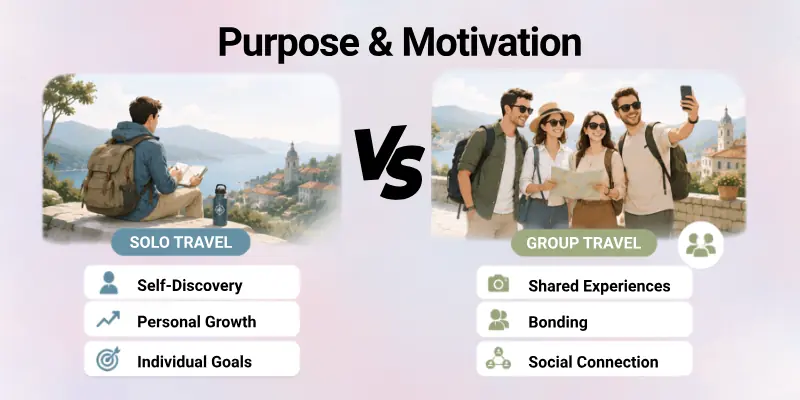
How Solo Travel Differs:
- Often for self-discovery and reflection
- Personal growth and independence
- Private exploration and exploration
- Healing or decompressing emotionally
- Focused on individual goals
How Group Travel Differs:
- Often for shared vacations and bonding
- Family gatherings, student trips, or tours
- Celebrations and collective experiences
- Enjoyment through team activities
- Motivated by social connection
7. Decision-Making
The term “decision-making” refers to the process by which individuals select activities, routes, and times. It has an impact on the flow of travel and satisfaction.
How Solo Travel Differs:
- One person makes all decisions
- Decisions can change anytime
- No negotiation or compromise
- Personal priorities drive the journey
- Faster decision-making process
How Group Travel Differs:
- Decisions made collectively or by leader
- Needs agreement or compromise
- Different preferences must align
- Slower adjustments during travel
- Priorities balanced across the group
8. Cultural Interaction
Cultural interaction involves engaging with local traditions, languages, customs, and communities. It shapes learning and connection during travel.
How Solo Travel Differs:
- More likely to interact with locals
- Higher cultural immersion
- Must communicate independently
- Encourages learning new customs
- Authentic experiences more common
How Group Travel Differs:
- Interactions mostly within the group
- Limited cultural immersion
- Tour guides filter interactions
- Language and culture barriers reduced
- Less direct connection with locals
9. Travel Pace & Itinerary Style
How quickly or slowly a journey moves forward is referred to as its pace. The way in which activities are organized and balanced is referred to as the itinerary style.
How Solo Travel Differs:
- Adjustable pace based on mood
- Can rest or explore anytime
- No pressure to rush or slow down
- Personalized activity scheduling
- Freedom to skip attractions
How Group Travel Differs:
- Pre-set pace and routine
- Timed visits and structured stops
- Must follow itinerary strictly
- Uniform activity participation
- Reduced flexibility in timing
Combined Importance
The comparison between solo and group travel shows that both approaches play a vital role in tourism. Solo travel helps build independence and personal growth, while group travel enhances bonding and shared experiences. The travel and tourism industry supports both through packages, accommodations, tours, and destination management services, enabling travelers to choose what fits their preferences.
Final Note
In this comprehensive guide, we have covered the complete breakdown of solo travel vs group travel, analyzed their key differentiating factors, and explained how each travel mode influences personal comfort, safety, planning, and experience. Both forms have their benefits and challenges depending on individual personality and trip objectives.
Personal Advice
If you enjoy freedom, self-exploration, and flexibility, solo travel may suit you well. If you prefer social environments, guided convenience, and shared experiences, group travel is a better fit. Evaluate your comfort level, budget, and travel goals before deciding.
FAQs
Here are some of the most commonly asked questions related to the solo vs group travel topic:
The difference between solo and group travel is that solo travel focuses on independent journeying, while group travel involves traveling with companions or organized tours.
Traveling by oneself can be risk-free if the appropriate precautions, planning, and awareness are taken. Depending on the traveler’s experience, the destination, and the safety practices, the risk can vary.
Group travel can be cheaper because costs such as rooms, transport, and tours can be shared or discounted. However, premium tour packages may cost more.
Because solo travelers can alter their plans at any time without the group’s consent, solo travel offers greater flexibility. Schedules for group travel are set.
At hostels, tours, cafes, or events, a lot of lone travelers make new friends. Social interaction, however, is influenced by both environment and personality.
A number of reasons influence people’s decision to travel in groups: shared experiences, safety, convenience, and the opportunity to bond with friends or family.
There is a reduction in stress associated with group travel because the leaders or organizers of the group typically handle the logistics and plans.
Solo travel is appealing to individuals who are self-reliant, introspective, and adventurous, and who place a high value on freedom and exploring at their own pace.
However, this is contingent upon the dynamics of the group as well as the level of social comfort. While some introverts prefer to be in structured groups, others prefer to be alone and enjoy their privacy.
Solo travel typically provides a more direct cultural immersion experience than other types of travel because it allows travelers to interact more with locals and to navigate challenges on their own.






- Be Respectful
- Stay Relevant
- Stay Positive
- True Feedback
- Encourage Discussion
- Avoid Spamming
- No Fake News
- Don't Copy-Paste
- No Personal Attacks
- Be Respectful
- Stay Relevant
- Stay Positive
- True Feedback
- Encourage Discussion
- Avoid Spamming
- No Fake News
- Don't Copy-Paste
- No Personal Attacks
